














What Is a Garfish?
'When the rapeseed begins to bloom, the garfish swims to the coast.'
That's an old saying from the north. In this article you'll find my methods, my favourite spots, a few tips and a recipe for cooking garfish.
For anyone unsure when rapeseed blooms: it's in May. The full garfish season, however, runs from May through to August.
Garfish can grow up to 90 cm long and are genuinely tasty table fish. They're sharp-eyed predators that hunt by sight, which is why it makes sense to fish for them during daylight hours.
Methods and Tackle for Garfish
In my opinion, the garfish is one of the easiest fish to target in the Baltic. You can catch them using a wide range of methods, including:
- fly fishing,
- a float rig,
- spoons,
- Sbirolino
- or simply small jigs.
My personal favourite is the spoon — and there's not much to say about it, because once the shoal arrives, they'll take anything that moves and glitters.
Which Spoon Works for Garfish?
When the fish are on, it really doesn't matter whether you're fishing 18 g or 22 g spoons, blue-and-white checked or green-and-yellow striped. I personally stick to two brands: Snaps and Falkfish. Other brands will certainly catch too, but I have a particular confidence in these manufacturers — they've helped me pick up the odd straggler right at the tail end of the season more than once.
Further Tackle for Garfish Fishing
In front of my spoons I tie roughly 40 cm of 0.40 mm fluorocarbon leader, since there's every chance a sea trout might take during garfish season. For garfish, a soft, sensitive rod is the way to go — ideally with a casting weight of 8–25 g. A simple fixed spool reel loaded with 0.12 mm braid is more than enough.
Here's a quick tip:
If you're getting a lot of missed bites and follows, remove the treble hook on your spoon and tie a piece of line roughly 5 cm long between the treble and the spoon body.
This trick works well because garfish have a very hard beak at the front, where treble hooks simply can't get a proper hold. The cartilage towards the back of the mouth is a little softer, so you'll connect far more reliably there.
Because of that hard mouth, it's especially important to use razor-sharp hooks rather than old, rusty ones. Follow just these two tips and you'll see a significant improvement in your catch rate.

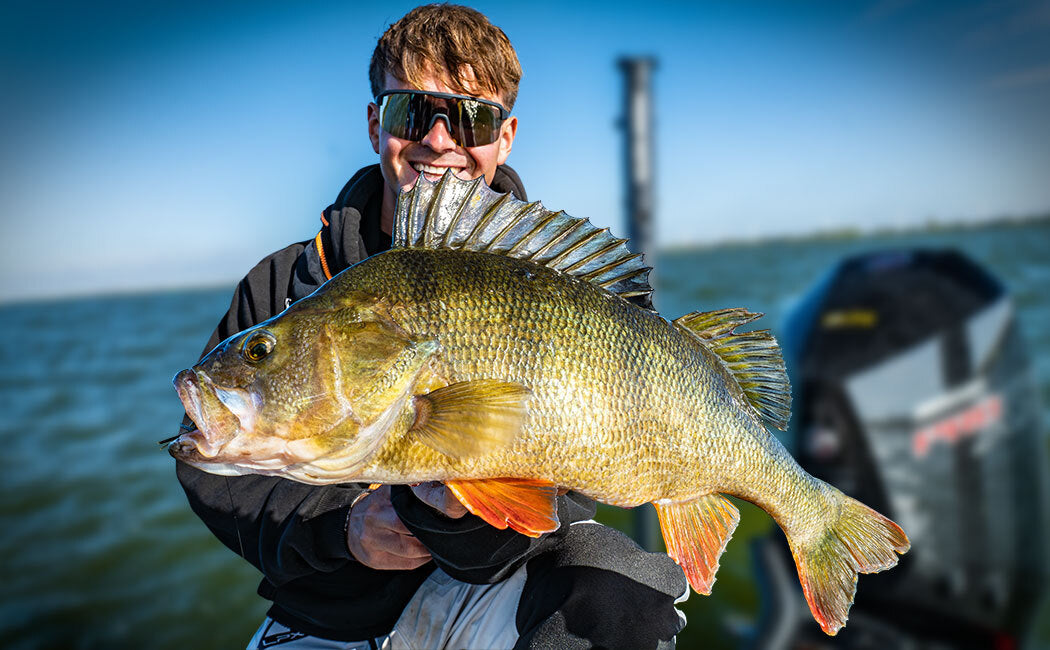
Patrick Owomoyela with his first garfish
Go Smaller With Your Treble Hook
Here's the third and final key tip: spoons bought off the shelf at your local tackle shop will often come fitted with treble hooks that are far too large for a garfish's narrow beak. Take the treble off and swap it for a smaller one.
A great alternative is to use silk loops tied in place of the treble hook. The garfish's fine teeth grip silk very easily, which dramatically reduces missed bites.
There is one significant downside, though: if a sea trout takes, the chances of landing it are very slim.
Using a Float Rig
Another approach I enjoy is the float rig. I use a long-stemmed 15 g float, set up with a standard float trace — a stopper either side of the float, then shot added to balance it correctly.
For hooks, I use size 1 single hooks from Gamakatsu. I then prepare a small strip of herring sized to suit a garfish's narrow beak — it really is important not to cut it too large, as these fish have a very small mouth.
It's also worth noting that the bait shouldn't be fished close to the bottom as you might with other species; instead, keep it no more than 2 metres below the surface.
Choosing Your Spot for Garfish
My personal patch, as some of you may know, is the Baltic coast — the Darß peninsula in particular. There are many good garfish spots across Germany, but the most productive tend to be brackish waters, such as the Bodden lagoons — for example the Strelasund or the Rügener Bodden.
Fishing for garfish from a Bodden is especially interesting because your spoons may also tempt freshwater predators.
Finding the Right Spot From the Bank
For bank fishing, any shallow area will do — particularly flat, sandy beaches, much like when targeting sea trout.
Fishing from piers or jetties can also be very productive, provided the bottom is sandy and the water isn't too deep. Garfish also tend to show well at spots with a 'leopard-skin' pattern on the bottom — alternating patches of sand and weed or mussels.
Cooking Garfish
Garfish don't have the best reputation as a food fish — unfairly, I think. So here's my simple recipe for garfish dusted in flour.
Preparation time: 20 minutes for 4 people.
You'll need:
- 1 cup of flour
- Salt and pepper
- 2 cloves of garlic
- Butter & rapeseed oil
- Dill
- 1 lime
Method:
- Gut the garfish, remove the head, scrape off the scales and trim the fins
- Cut the fish into pan-sized portions — roughly 20 cm pieces
- Pat the fish thoroughly dry with kitchen paper
- Dust the fish inside and out with flour
- Shake off any excess — there should be no floury clumps on the fish
- Heat the pan(s) with equal parts butter and rapeseed oil
- Add the garlic to the fat
- Add the garfish
- Remove from the pan once the skin is golden brown and crispy (see photo), scatter over some dill and squeeze over the lime
- Serve with a tasty side such as rosemary potatoes
One bonus of cooking garfish is that the bones turn bright green after frying, making them particularly easy to spot and remove while you eat.

Summary
I hope you've enjoyed this article and picked up something new. Enjoy your meal — and, as always, tight lines!
Your Brosef

