












What Are Spinners?
Spinners have been around for roughly 130 years, ever since the brand Pflueger launched its very first self-rotating lure — the Luminous. Today there are hundreds of different variants, but they all share one defining feature: a rotating metal blade. That spinning blade triggers a remarkable response underwater, because it works on several different levels at once:
Visual Attraction
A spinner may not look much like a fish out of the water, but the moment it starts rotating below the surface it becomes a flashing, glinting body — a dead ringer for a baitfish bolting through the water in a panic.
Pressure Waves
The rotating blade generates pressure waves that a predator picks up through its lateral line. Few lures produce as much stimulation on this level as a spinner.
When the water is heavily coloured and visual signals are severely reduced, that pressure-wave effect makes the spinner an absolute trump card.
Even against well-fed, disinterested predators, those pressure cues can make all the difference.
Scent: Attractants in Spinners
Less common in Germany but genuinely worth knowing about are spinners fitted with a screw-on hollow body, into which you can load attractants or other trigger substances. Fished very slowly in winter, when an attractant has time to disperse through the water, this can provide a useful extra dimension of stimulation.
Acoustic Signals
The friction generated by the rotating blade also produces subtle acoustic signals. On overcast days, when visual attraction is at its weakest, those sounds can help draw a predator's attention to the lure.
Which Fish Are Attracted to Spinners?
Predators such as asp, perch and various salmonid species are absolutely mad for a rotating metal blade. The spinner is of course a top-class lure for pike of all sizes, but it also works brilliantly on predatory non-predatory species such as chub and ide — and occasionally even the odd predatory bream will fall for one. With the right specialist spinner you can even land zander, but more on that later.
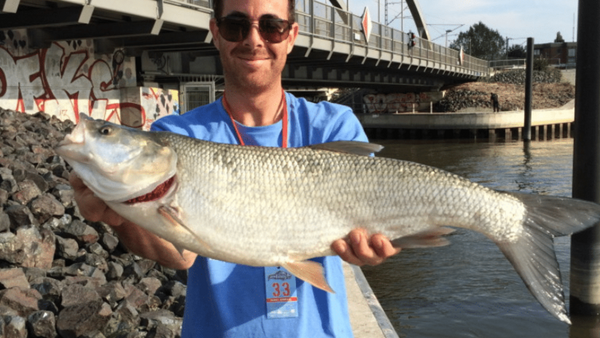
Daniel's personal-best asp took a classic neon-yellow size 3 spinner in Hamburg
Which Types of Spinner Are There?
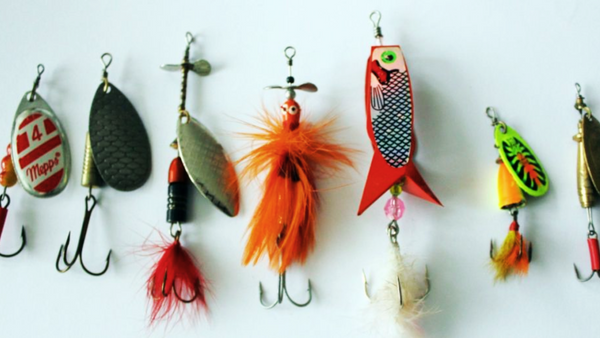
Spinners come in a wide range of styles, including:
- Bullet-head spinners
- Spinnerbaits
- Buzzbaits
- Tandem spinners
- Jig spinners
Bullet-Head Spinners
As the name suggests, bullet-head spinners carry a lead head that lets you fish effectively at greater depths — ideal for deeper spots.
Spinnerbaits
Spinnerbaits are hugely popular in the United States for largemouth bass and muskies. They consist of two wire arms: one carries one or more rotating blades, the other holds a body — usually paired with a skirt — and that is also where the hook sits. Their construction means they are remarkably snag-resistant, and weed beds can be fished with spinnerbaits quite effectively.
The main drawback is missed takes on the blade arm, where there is no hook.
Buzzbaits
Buzzbaits are closely related to spinnerbaits and share a similar design. The key difference is a propeller-style blade that does not need to be fully submerged to work — which means you can run buzzbaits right across the surface.
Tandem Spinners
The tandem spinner is another interesting variation, carrying 2 metal blades to generate more pressure waves and deliver even more stimulation to a predator. Tandem spinners are usually at their best on calm, large lakes, where you need to create more underwater activity to attract fish from a greater distance.
Jig Spinners
Jig spinners are noticeably heavier than standard spinners, which allows them to sink deeper. That makes them excellent search lures when you need to cover large areas of water.
Watch Enrico demonstrate how to fish with jig spinners in this video:
How Does a Spinner Work?
For a spinner to rotate properly and 'work' correctly, every component needs to be well made. The metal blades must be securely and freely mounted on the wire and curved at the right angle to spin correctly. Wider blades displace more water, creating greater resistance on the retrieve and causing the spinner to run shallower — the opposite of narrower blades, which run deeper.
Spinner Patterns and Finishes
Alongside the various shapes, there is no shortage of patterns and finishes to choose from. Some blades are strikingly bright, others far more subdued; some feature engraved scale patterns, while others carry bold, eye-catching designs.
Quick tip: A spinner is an active lure that stimulates predators on multiple levels — but it is not uncommon for a fish to follow it for several metres and then peel away at the last second. There is a simple trick that can turn that follower into a taker:
About 5 metres before the lure reaches the bank or the boat, speed up your retrieve by 2 or 3 turns of the handle. In many cases that triggers a lightning-fast last-minute attack.
New Developments and Specialist Variants
Zander on a spinner? Absolutely possible. Our American angling friends developed a dedicated spinner for zander fishing: it has a heavy, pointed lead head and a slim, plain blade, fitted with a single hook onto which strips of fish or pieces of crayfish are often threaded for extra attraction.
Hybrid set-ups also work well for zander — for example, a soft lure on a standard jig head with a single spinner blade attached as an added trigger, creating an interesting high-action presentation.
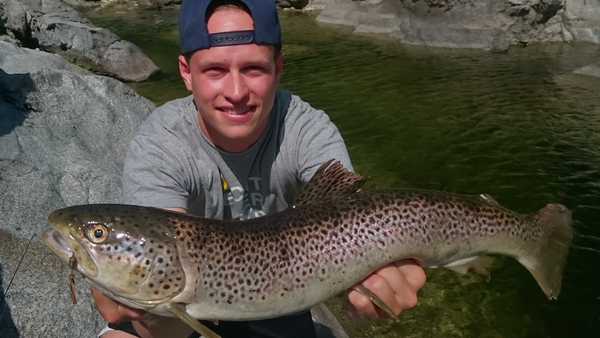
Toni's personal-best brown trout fell for a small brown-and-white size 2 spinner
Are Spinners Old-Fashioned?
So why does the spinner seem to be fading from memory, at least in Germany? You see fewer and fewer anglers these days giving it a regular dip in the water.
The Downsides of Spinners
The lure does have a few drawbacks**, it has to be said. The rotating blade causes significant line twist surprisingly quickly — though fitting a good-quality swivel just above the lure reduces this dramatically. Alternatively, you can bend the wire at a 40-degree angle just below the line eye, which also helps, though not all models allow for this.
Storing spinners and retrieving them from the lure box can also be a fiddly business, as the treble hooks love to tangle with one another. Swapping the treble for a single hook solves the problem — it is also easier on the fish, and many anglers find that a hooked fish is less able to lever out a single hook than a treble.
The other minor annoyance is that the wire can bend out of shape during the fight — but that is a small price to pay when you are landing a hard-earned catch with a smile on your face.
An Under-Marketed Lure
On balance, the declining use of spinners in Germany cannot really be down to any lack of fish-catching ability. While there are certainly situations where a spinner is not the ideal choice, there are plenty of contexts in which it genuinely excels.
What stands out is that this 'traditional' lure receives far less marketing attention than other lure types. The suspicion is that the industry simply has fewer variations and innovations to sell compared with soft lures and plugs — and perhaps the margins are not as attractive either. That may well be why other lures tend to come to mind first when anglers are plotting their next session.
Summary
On days when soft lures and other lures are drawing a blank, give the spinner the chance it deserves. Because you all know the saying: spinners always work!
We wish you rattling reels and tight lines!

